Designing the Blended Environment
The students we’re educating today don’t know the world without the internet and technology. I’m not talking about computer labs that students could sign up to use. Today's school technology represents a huge leap forward. Its personal, mobile and universal. So how do educators keep up? We must continue learning and ask ourselves important questions. I believe it's necessary to shop for the best model to fit your circumstances. There are important considerations about implementation and approaches that should be examined to ensure a successful transition. The following six questions are key for helping teams home in on the options that are most likely to match their circumstances, constraints, and ideals.

Here are the 7 questions presented:
- What problem are you trying to solve?
- What type of team do you need to solve the problem?
- What do you want students to control?
- What do you want the primary role of the teacher to be?
- What physical space can you use?
- How many internet-connected devices are available
- What model will best serve you and your students' needs?
Let’s start with the problem that is trying to be solved. Considering my personal classroom community, I am trying to tackle an issue related to mainstream students in core subjects. I am not addressing a nonconsumption gap. The needs lie with students who enter the district with wide disparities in reading and math skills. Nonconsumption problems include the need for credit recovery or access to courses outside the course. In general today, models of blended learning are better matches for core problems. Disruptive technologies in early form are ill-equipped to compete against the existing system. The main problem I am trying to solve is core problems involving mainstream students. The model or set of models that is sustaining to the traditional classroom, such as the station Rotation, Lab rotation or flipped class would be best for this type of problem.
 Next, I would look at what type of team is needed to solve the problem. Using a functional team would only help to solve a small problem; with this teams will be unable to implement blended learning models. Functional teams do not have the power to create a truly transformative learning model on their own. A lightweight team would address the problem and require coordination with other parts of the school, outside of the classroom, department or grade level teachers. This option is well suited to implement station rotation or lab rotation. We do not need architectural changes, new schedules or staffing arrangements, which the heavyweight teaming would address. I believe it is also important to find out what’s essential to my administrators and coworkers. Is it test scores? Safety? Personalized learning? We recently used a heavyweight team to adapt a leadership committee, and used that team to inspire the 7 Habits of Happy Kids school-wide. I want to demonstrate that I can still meet all of their guidelines and ensure that their vision for the school can still be achieved within this environment. Involving them from the beginning is a key to strong administrative support. My coworker is also my role model when it comes to teaching. I learn so much from her, and we have a great relationship. It is because of this that I could easily recommend my ideas to her. Not only would she be on a lightweight team for blended learning, she would play a huge role on it.
My favorite question is what do you want students to control? How much control do I want to give students over the time, place, path and pace of their learning? As stated in Blended: Using Disruptive Innovation to Improve Schools, online learning opens the potential for students to chart a personal course that would have been impossible to manage in a traditional classroom with thirty students and one teacher (Horn, 227). I teach second grade, so before anything, I need to teach students autonomy. Online learning, if explained correctly, allows for students to control the pathway, control the pace. Blended learning models enable students to manage their speed and path for a portion of the course. Station rotation, lab rotation, and flipped classroom are options to limit student control to some extent. In station rotation and lab rotation, students can move as fast as they want while they are sitting with their computers working on their own. But when they are asked to switch, the student usually falls back in sync with the group pace and is able to collaborate more with peers. If I have learned anything about primary and technology, is that if you give them an inch they ask for a mile. Giving them technology is like giving candy to a baby! However, if I start slow and steady, I believe students will be absolutely engaged and in love with a Station Rotation system with blended learning.
The next question addresses the primary role of the teacher. Most traditionally, teachers deliver face to face direct instruction. The next level of teacher involvement is providing face to face tutoring, guidance and enrichment to supplement online lessons. Station Rotation and lab rotation teachers typically spend class time delivering face to face instruction in small groups. I love this because I can then also monitor the other stations and modalities.
Next, I would look at what type of team is needed to solve the problem. Using a functional team would only help to solve a small problem; with this teams will be unable to implement blended learning models. Functional teams do not have the power to create a truly transformative learning model on their own. A lightweight team would address the problem and require coordination with other parts of the school, outside of the classroom, department or grade level teachers. This option is well suited to implement station rotation or lab rotation. We do not need architectural changes, new schedules or staffing arrangements, which the heavyweight teaming would address. I believe it is also important to find out what’s essential to my administrators and coworkers. Is it test scores? Safety? Personalized learning? We recently used a heavyweight team to adapt a leadership committee, and used that team to inspire the 7 Habits of Happy Kids school-wide. I want to demonstrate that I can still meet all of their guidelines and ensure that their vision for the school can still be achieved within this environment. Involving them from the beginning is a key to strong administrative support. My coworker is also my role model when it comes to teaching. I learn so much from her, and we have a great relationship. It is because of this that I could easily recommend my ideas to her. Not only would she be on a lightweight team for blended learning, she would play a huge role on it. My favorite question is what do you want students to control? How much control do I want to give students over the time, place, path and pace of their learning? As stated in Blended: Using Disruptive Innovation to Improve Schools, online learning opens the potential for students to chart a personal course that would have been impossible to manage in a traditional classroom with thirty students and one teacher (Horn, 227). I teach second grade, so before anything, I need to teach students autonomy. Online learning, if explained correctly, allows for students to control the pathway, control the pace. Blended learning models enable students to manage their speed and path for a portion of the course. Station rotation, lab rotation, and flipped classroom are options to limit student control to some extent. In station rotation and lab rotation, students can move as fast as they want while they are sitting with their computers working on their own. But when they are asked to switch, the student usually falls back in sync with the group pace and is able to collaborate more with peers. If I have learned anything about primary and technology, is that if you give them an inch they ask for a mile. Giving them technology is like giving candy to a baby! However, if I start slow and steady, I believe students will be absolutely engaged and in love with a Station Rotation system with blended learning.
The next question addresses the primary role of the teacher. Most traditionally, teachers deliver face to face direct instruction. The next level of teacher involvement is providing face to face tutoring, guidance and enrichment to supplement online lessons. Station Rotation and lab rotation teachers typically spend class time delivering face to face instruction in small groups. I love this because I can then also monitor the other stations and modalities.
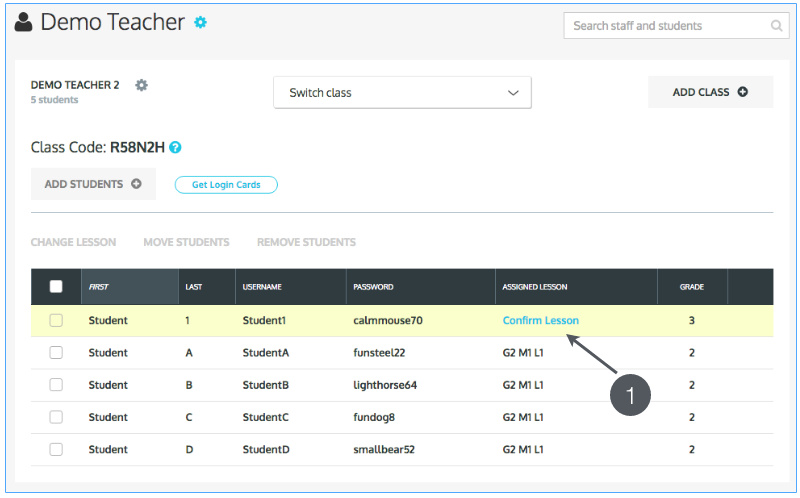
Most apps allow the teacher to view student work instantly. I use Zearn, a math program that allows students to work at their own pace. I am able to log in and view how they are doing with the online lessons. But almost all of the station rotation and lab rotation instances in research feature face to face instruction as a prominent element of the blended course. In contrast, teachers of disruptive models flip from being the primary source of lessons and content in person to being a face to face guide who help students travel through the knowledge and abilities they develop preliminarily online. This is not a version of education that my community is ready to adapt to.
What physical space can you use to implement a sustaining model? A significant constraint to consider is the reality of the available physical facility space. Accommodations at my building include existing classrooms and a computer lab. There are no sizeable open learning spaces, except for the courtyard outside. Luckily, most station rotation and lab rotations develop within existing classrooms. They usually require furniture rearrangement and electrical outlets, but most commonly the existing floor plan of the traditional class can be accommodating. My building has a computer or lab for the online learning station. My classroom utilizes a number of flexible seating. I have a decent amount of space and tables. If I chose a station rotation, I would be able to create an environment that looks like the following.
The most difficult question involves how many internet-connected devices are available. I would love to ultimately have 1-1 device ratio. However, I do not. Because I have fewer access students have to devices, the fewer models will work. Currently, there are enough devices for a fraction of the students. Our tablets are great for watching videos and other media but don't necessarily help them to compose essays or produce digital projects on them nearly as well as if they had a full-sized keyboard and screen (laptop). Thus, we have the computer lab to utilize in this instance. Since some models of blended learning work well in classrooms that do not have one to one ration, that is what I will be designing. The internet provides the backbone of student learning in both station rotation and lab rotation models, and students need to be able to access online content and instruction without waiting. My community cannot currently handle one device per child, not only at school but at home as well. The majority of my students do not have internet at home. The option for disruptive models require students to have access to a device on campus and off campus.
So the ultimate question is: What model will best serve you and your students' needs?

I have prioritized the issues that matter most or are deal breakers and created the following diagram. I choose a model by analyzing which models fit my needs in the most ways and in the highest priority ways. Based on the facts, I will most likely rely on a Station Rotation to help students complete a competency-based core curriculum. A Station Rotation model and schedule of blended learning seems like a natural fit, and can be very effective. Research and data from this article, Blended learning transformed our school, from the ISTE webpage, considers the importance of using Station Rotation in the Blended learning process. I would allow for the best face to face facets and the best facets of digital tools and online environment and merge them together. After mastering benchmarks, students can set forth on a personalized pathway with the freedom to choose.
Question
|
Station
Rotation |
Lab
Rotation |
Flipped
Classroom |
Individual
Rotation |
Flex
|
A La Carte
|
What problem are you trying to solve?
|
1
|
1
|
1
| |||
What type of team do you need to solve the problem?
|
1
|
1
|
1
| |||
What do you want students to control?
|
1
|
1
|
1
| |||
What do you want the primary role of the teacher to be?
|
1
|
1
| ||||
What physical space can you use?
|
1
| |||||
How many internet connected devices are available?
|
1
|
1
| ||||
Total Points:
|
6
|
5
|
3
| |||
What model will best serve you and your students' needs?
|
✓
|
✓
|

For example, during math time, there are four stations. Station one would be math with technology with an online discussion board. They have a problem, use an app to solve it and submit their work on the discussion board where the teacher can view it. There are many apps that do this well. There's math with myself, which is independent problem-solving or an independent activity set up with manipulatives. And then there’s teacher time, the small group teacher station. Teachers get 100% of attention and can differentiate these groups. I can truly engage them in the subject based on their prior knowledge and depth of understanding. It also gives more time to connect on a personal level with students and build relationships. The final station has students working together and feeding off of each other, using a math app on the iPads. They help each other collaborate within the virtual learning environment. This helps with critical thinking and communication as well.

When I think about Station Rotation and what it would look like in my classroom, I consider this diagram. I think that customizing and combining models for personal and students needs are critical. The blended learning models are already good enough, there is no need to recreate the wheel. I could adapt to include a Lab Rotation as well, to utilize the lab so students are seeing another version of the technology. I am also able to check out laptops to use in the Station Rotation in the classroom. In the long run, I would love to have a PBL or STEM bin to incorporate. I want to be an educator that continually improves their practice by learning from and with others in a lightweight team and explores proven and promising practices like blended learning that leverages technology to improve student learning.
Resources:
Allen, S. (2017, July 2). Blended learning transformed our school. Retrieved June 20, 2018, from https://www.iste.org/explore/articleDetail?articleid=896&category=Lead-the-
Horn, M. B., Staker, H., & Christensen, C. M. (2017). Blended: Using disruptive innovation to improve schools. San Francisco, CA: Jossey-Bass.Resources:
Allen, S. (2017, July 2). Blended learning transformed our school. Retrieved June 20, 2018, from https://www.iste.org/explore/articleDetail?articleid=896&category=Lead-the-
Investing in Students' Digital Future from Day One. (2016, April 08). Retrieved June 19, 2018, from http://digitalpromise.org/2014/04/13/blended-learning-in-early-elementary-at-utica-community-schools/
Minero, E. (2018, March 2). The Architecture of Ideal Learning Environments. Retrieved June 19, 2018, from https://www.edutopia.org/article/architecture-ideal-learning-environments


Comments
Post a Comment